

The guide to diamonds
From the shape that catches your eye to the details that make it shine. Get to know diamonds, one beautiful detail at a time.


Four details. One personal choice.
Cut, colour, clarity and carat weight give you a common language for comparing diamonds. Consider them together, alongside the stone’s appearance and your own style.
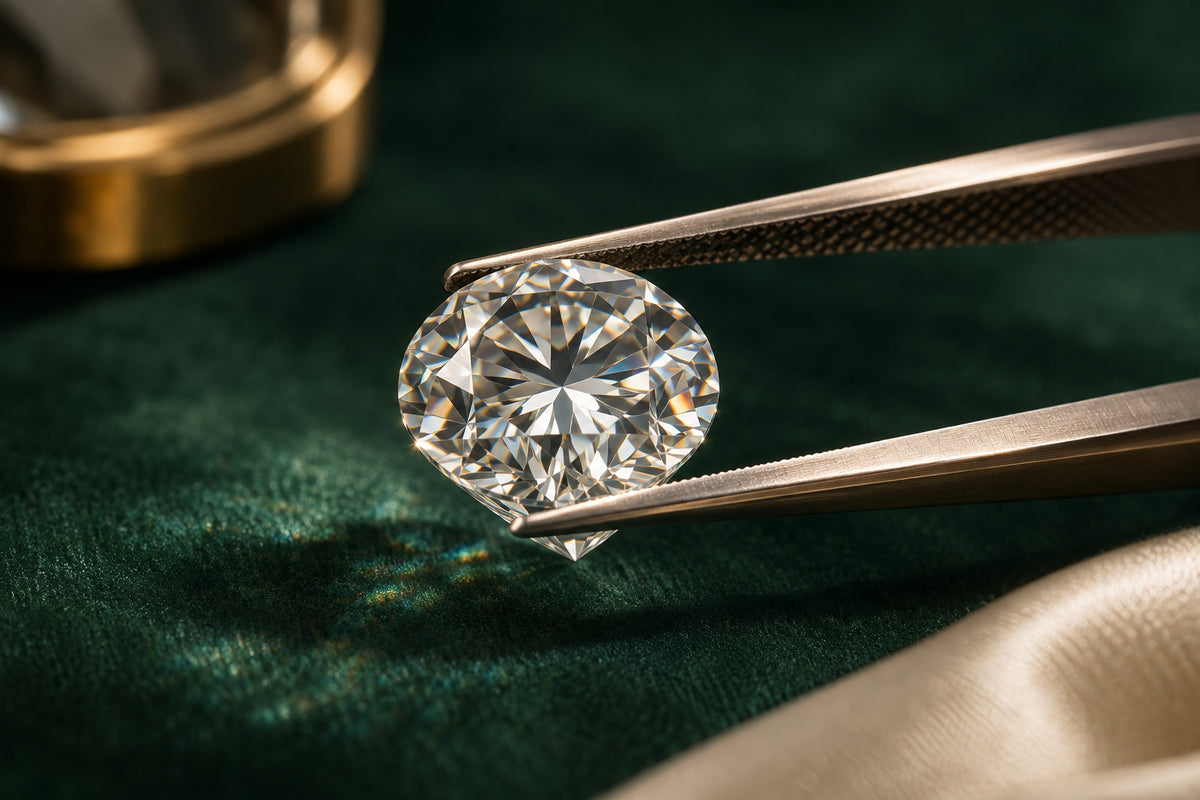
01 / Cut
The art of light
Cut describes how a diamond’s facets, proportions and finish work with light. Brightness, flashes of colour and the sparkle you see as a stone moves all contribute to its character.
Look at the diamond in motion and in different lighting. Its shape describes the outline; cut quality tells a different part of the story.
Choose the outline you love, then look closely at how the diamond performs in the light.
What to look for
- Proportions
- The relationship between the diamond’s angles, depth and face-up dimensions.
- Symmetry
- How consistently the facets align and meet.
- Polish
- The quality of the finished facet surfaces.
Cut-grading systems vary by laboratory and shape. GIA’s standard overall cut grade applies to eligible round brilliant diamonds.
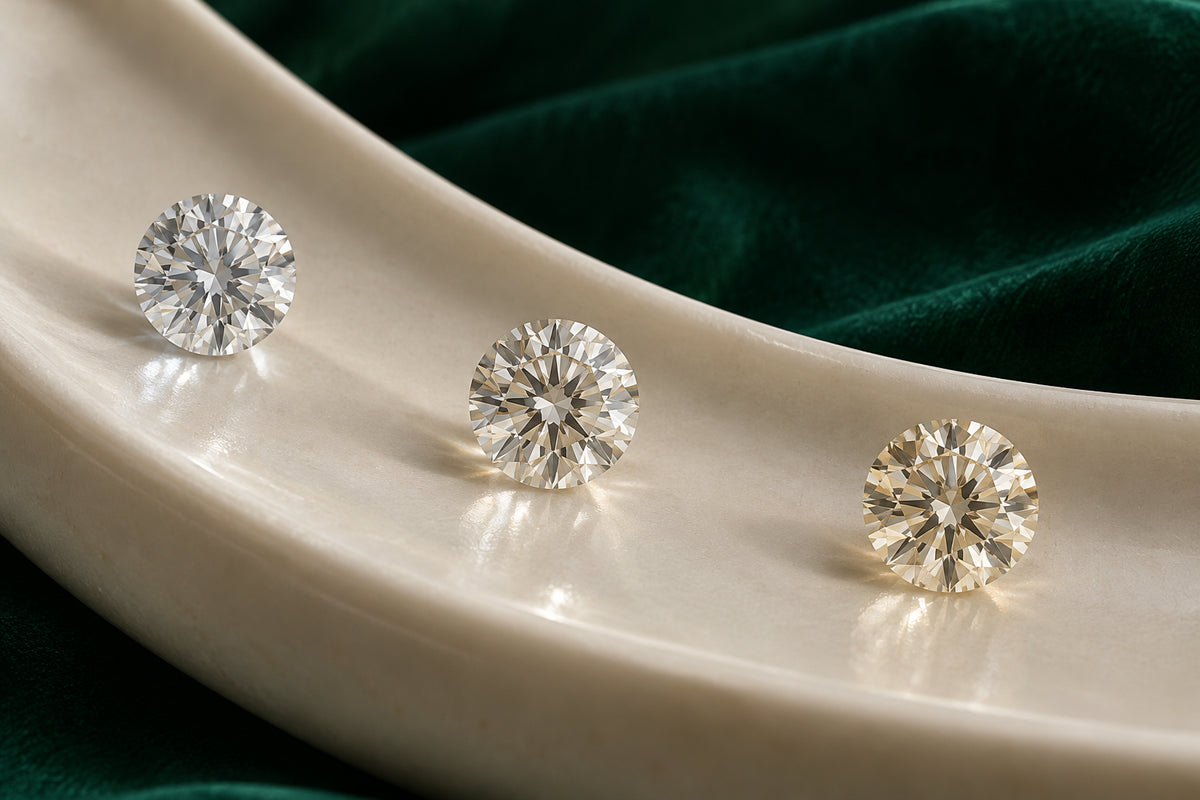
02 / Colour
A subtle spectrum
For diamonds graded on the D–Z scale, colour describes the degree of body colour. D sits at the colourless end; warmer yellow or brown tones become more noticeable towards Z.
The setting, lighting and shape can influence how colour appears. Compare stones beside one another before deciding what feels right for you.
Fancy-colour diamonds are assessed using a different approach to colour.
Understanding the D–Z colour groups
- D–F
- Colourless
- G–J
- Near colourless
- K–M
- Faint
- N–R
- Very light
- S–Z
- Light
Background colours are illustrative, not calibrated diamond colour samples. Report formats vary; not every laboratory-grown diamond report uses D–Z grades.
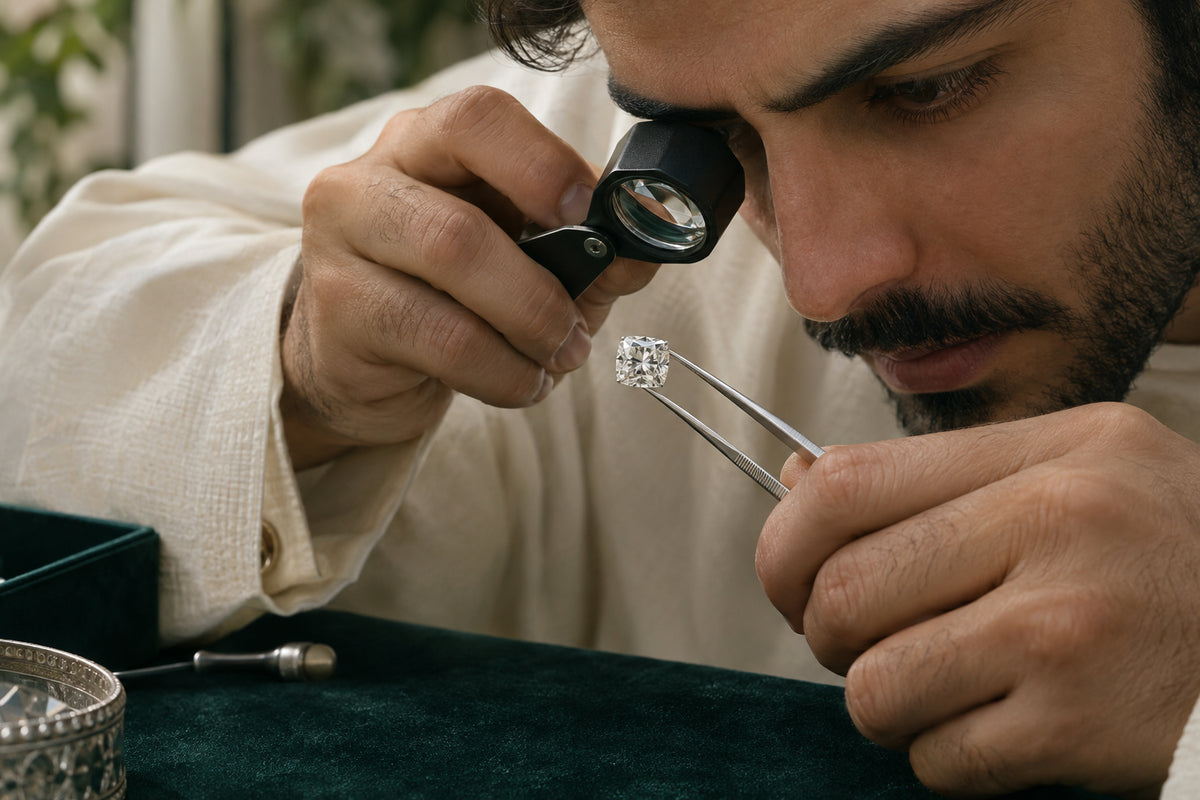
03 / Clarity
Beauty in the detail
Clarity considers internal characteristics, called inclusions, and surface characteristics, called blemishes. A grader assesses their size, number, position, nature and visibility under 10× magnification.
A grade is useful, but the individual stone matters too. Ask to view it closely and at a normal viewing distance.
“Eye-clean” is a viewing description, not a formal clarity grade. Visibility depends on the diamond and the viewing conditions.
The clarity scale, grouped
- FL
- Flawless
- IF
- Internally flawless
- VVS1–VVS2
- Very, very slightly included
- VS1–VS2
- Very slightly included
- SI1–SI2
- Slightly included
- I1–I3
- Included
These six groups contain eleven grades. Clarity is assessed at 10× magnification; a grade alone does not guarantee that a stone will look eye-clean.
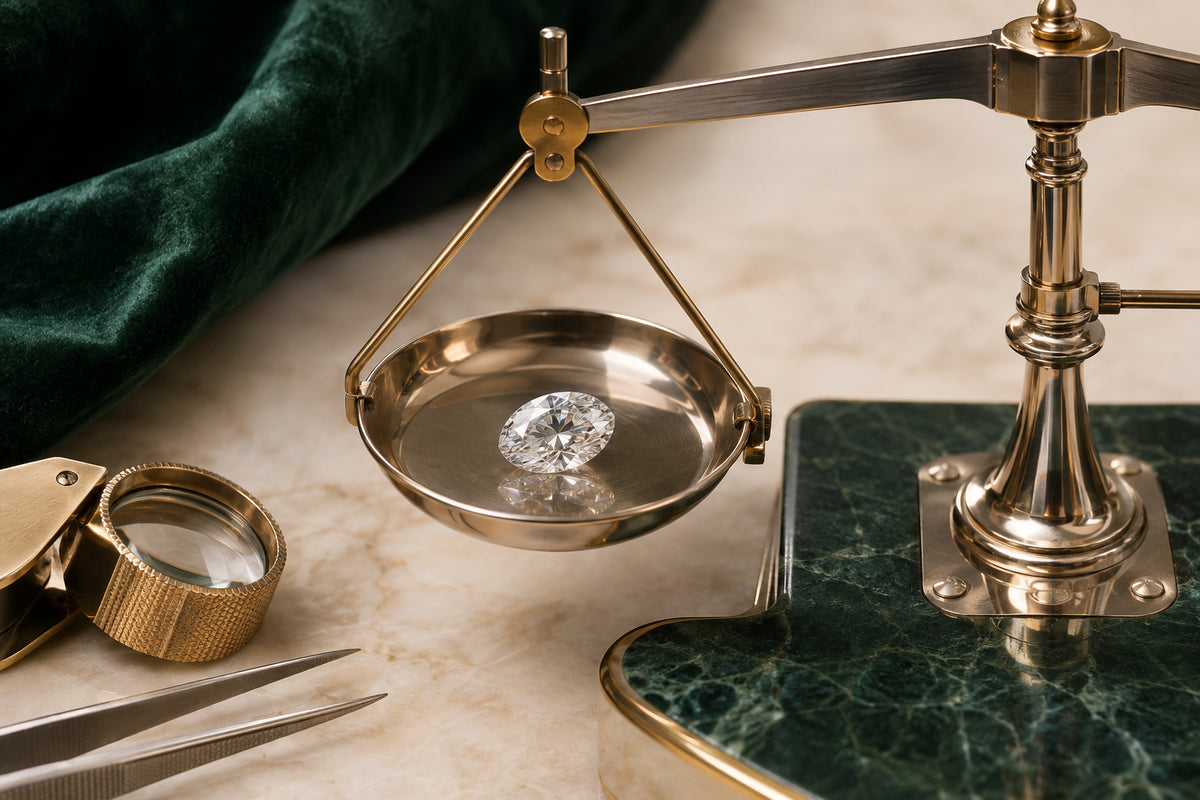
04 / Carat
Weight, with perspective
Carat measures a diamond’s weight. One metric carat equals 0.2 grams, and each carat is divided into 100 points.
Two diamonds of equal weight can look different in size because their shapes and proportions differ. Compare the millimetre measurements, the setting and the way each piece sits when worn.
For jewellery with several stones, check whether a quoted weight refers to the centre diamond or the combined total.
Carats translated into grams
- 0.50 ct
- 0.10 grams · 50 points
- 1.00 ct
- 0.20 grams · 100 points
- 1.50 ct
- 0.30 grams · 150 points
- 2.00 ct
- 0.40 grams · 200 points
Weight conversions are exact. Editorial photographs do not show diamonds at calibrated sizes.

A different beginning. A diamond all the same.
Laboratory-grown diamonds develop in a controlled environment rather than within the Earth. They are diamond, distinct from simulants such as moissanite or cubic zirconia.
Explore their origin, how they grow and the details to consider when choosing one.
Confidence in every detail
An independent grading report helps you understand the diamond you are considering. Depending on the report, it can record origin, measurements, weight and assessed quality characteristics.
Ask which report accompanies your chosen stone. Check its number through the issuing laboratory and compare the details with the diamond. Report formats and grading systems vary between laboratories.

Illustrative IGI sample artwork. The report supplied depends on the selected diamond.

Keep the brilliance close
Everyday oils can soften a diamond’s sparkle. Wipe jewellery gently with a clean, soft cloth, and ask your jeweller which cleaning method suits the stone, metal and setting.
Remove jewellery before swimming, exercise or household cleaning. Store pieces separately and have loose stones or worn settings checked before wearing them again.
A little more clarity
Answers to the questions that often come up when choosing a diamond.
Is diamond shape the same as cut?
Shape is the stone’s outline, such as oval, pear or round. Cut describes how it is faceted and, when discussing quality, how its proportions and finish work with light.
Which of the 4Cs should I prioritise?
Start with the shape and appearance you enjoy, then compare cut, colour, clarity and carat together. There is no single combination that suits everyone. Viewing individual stones helps you balance the details with your budget.
Does a higher carat weight always look bigger?
Carat measures weight. Face-up dimensions also depend on the diamond’s shape and proportions, so compare its millimetre measurements and how it looks in the setting.
Are lab-grown diamonds real diamonds?
Yes. Laboratory-grown diamonds have a diamond crystal structure. Their origin differs from natural diamonds, and specialist testing is used to distinguish them.
What should I check on a diamond report?
Check the issuing laboratory, report number, diamond origin, measurements and the quality information recorded. Verify the number with the laboratory. The report describes the stone; it is not a price valuation or a warranty.
Can you help me choose a diamond?
Contact Mirbaha with the shape, style and budget you have in mind. We can discuss available pieces and the individual diamond details before you make your choice.
Find the diamond that feels like you
Explore Mirbaha jewellery, or speak with us about the details that matter to you.

